

Welcome to Hydraulic online. We are Australia’s biggest Ecommerce store with thousands of products are great prices. Contact us for any enquiries.
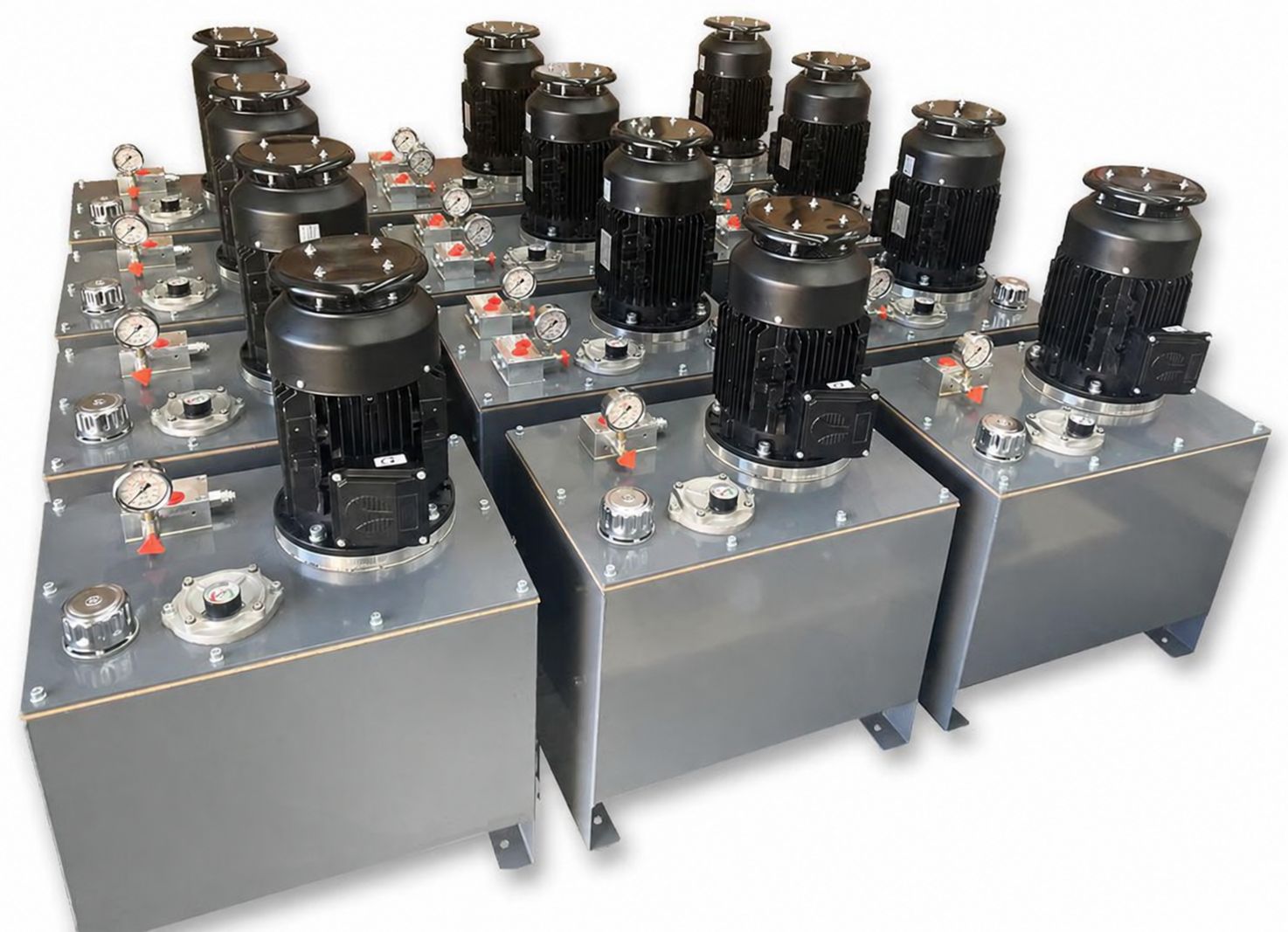
Build your own 415V 3 phase hydraulic power unit (IPU) online. Choose the electric motor, hydraulic pump, oil tank and oil distribution manifold or valve bank to suit your job and see the price update as you go.
Every unit in this range is rated up to 200 bar (3,000 psi). Supplied as a DIY kit, or assembled and ready to run: just add hydraulic oil and connect 415V 3 phase power.
Suits general industrial manufacturing machinery, presses, benders, lifting and clamping systems, test rigs, crushers, balers and log splitters,
Base Unit: What the Starting Price Includes
The price shown is for the base spec unit:
- Motor: 0.55 kW 415V 3 phase electric motor with drive coupling, bell housing and gaskets
- Pump: Group 1 gear pump with suction strainer, check valve, hose and fittings
- Tank: 25 L powder-coated steel tank and lid with cork gasket, filler breather, Level gauge with built in temperature indicator and tank top oil return filter
- Manifold: P + T (Pressure and Tank) Manifold with 1/2" BSPP ports, pressure gauge, isolator, internal hoses and fittings.
Upgrade any part using the dropdowns above. The price of each upgrade is shown next to the option.
Options Available
- Motors: 0.55, 0.75, 1.1, 1.5, 2.2, 3, 4, 5.5, 7.5, 9.2, 11, 15, 18.5, 22 and 30 kW (415V 3 phase)
- Pumps: Group 1, Group 2 and Group 3 gear pumps, plus Hi-Lo tandem pumps (Group 2/1, 2/2 and 3/2), based on Vivoil pumps
- Tanks: 25, 40, 70, 120, 200, 300 and 400 L powder-coated steel
- Manifolds and valves: 1/2" or 3/4" BSPP, P + T manifold, or CETOP 3 (NG6) multi stations with 1 to 6 valves and CETOP 5 (NG10) multi station with 1 to 5 valves, options for Chinese or Italian-made valves.
Multi-Station Manifold setups include a cartridge unloader valve.
How to Choose Your Hydraulic Power Unit
Work through the four dropdowns in order: Motor, Pump, Tank, then Manifold & Valves. You only need two numbers to start: flow (how fast things move) and pressure (how much force you need).
Work Out Your Flow and Pressure
Flow (L/min) sets the speed. More flow means cylinders extend faster and hydraulic motors spin faster.
Cylinder volume (L) = 0.785 × bore (cm) × bore (cm) × stroke (cm) ÷ 1,000
Flow (L/min) = volume (L) ÷ time to extend (seconds) × 60
Example: an 80 mm bore cylinder with a 500 mm stroke extending in 10 seconds: 0.785 × 8 × 8 × 50 ÷ 1,000 = 2.5 L, and 2.5 ÷ 10 × 60 = 15 L/min.
Pressure (bar) sets the force. More pressure means more push from cylinders and more torque from motors.
Pressure (bar) ≈ force needed (kg) ÷ piston area (cm²)
Piston area (cm²) = 0.785 × bore (cm) × bore (cm)
Example: to push 10 tonnes (10,000 kg) with an 80 mm bore cylinder, the area is 50.3 cm², and 10,000 ÷ 50.3 = about 200 bar.
Tip: add around 10–15% to your pressure to cover losses in hoses and valves.
Step 1: Choose Your Motor (kW)
The motor must be big enough to deliver your flow at your pressure:
kW = (Flow L/min × Pressure bar) ÷ (612 × 0.85)
Round up to the next motor size in the dropdown. If your answer lands right on a motor size, go up one size. An undersized motor will overheat and trip.
Example: 15 L/min × 200 bar ÷ 520 = 5.8 kW, so pick the 7.5 kW motor.
Step 2: Choose Your Pump (Group 1, 2, 3 or Tandem)
The pump makes the flow. Pumps come in groups by physical size. Approximate ranges on a standard 4-pole motor (about 1,450 rpm):
| Pump | Displacement | Flow range | Typical use |
|---|---|---|---|
| Group 1 | about 1–10 cc/rev | about 1–13 L/min | Small presses, clamping, small tools |
| Group 2 | about 4.5–30 cc/rev | about 6–40 L/min | Most general industrial units |
| Group 3 | about 22–90 cc/rev | about 30–125 L/min | High flow, large cylinders, hydraulic motors |
Displacement (cc/rev) = Flow (L/min) × 1,000 ÷ motor rpm
Example: 15 L/min × 1,000 ÷ 1,450 = 10.3 cc/rev, so a Group 2 pump of about 11 cc.
The largest pumps in each group are rated for lower pressures. If you need the full 200 bar and you're near the top of a group's range, go up to the next group.
When to choose a Hi-Lo tandem pump:
- Fast approach, then high force: a large pump moves the cylinder quickly at low pressure, then a small pump takes over for the high-pressure work. You get speed and force without a huge motor. Ideal for log splitters, presses and crushers.
- Two separate circuits: each pump runs its own function at the same time, with no speed loss between them.
Step 3: Choose Your Tank
The tank stores the oil and helps it shed heat. As a rule, tank size = 2 to 3 times your pump flow (L/min).
| Pump flow | Minimum tank |
|---|---|
| Up to 12 L/min | 25 L |
| 13–20 L/min | 40 L |
| 21–35 L/min | 70 L |
| 36–60 L/min | 120 L |
| 61–100 L/min | 200 L |
| Over 100 L/min | 300–400 L |
Go up a tank size if the unit runs continuously or for long shifts, is installed somewhere hot or poorly ventilated, or your cylinders are large and draw a lot of oil out of the tank when they extend.
Step 4: Choose Your Manifold & Valves
- How many functions do you need to control? Each cylinder or motor you want to control separately needs its own valve station.
- Single-acting or double-acting cylinders? Single-acting cylinders push out under power and return by gravity, load or a spring. Double-acting cylinders are powered both out and back in. Most industrial cylinders are double-acting.
- How will you operate it? Choose a P + T manifold only if your valves are mounted remotely on the machine or you're supplying your own valve bank. Otherwise choose a CETOP 3 or CETOP 5 bank with the number of valve stations you need.
CETOP 3 (NG6) valves suit most small to medium units. CETOP 5 (NG10) valves suit higher flows. Multi-valve setups include a cartridge unloader valve that lets the pump idle at low pressure when no valve is operated, reducing heat and power use.
Quick-Pick Guide (200 bar / 3,000 psi)
| Flow you need | Motor | Pump | Minimum tank |
|---|---|---|---|
| 10 L/min | 4 kW | Group 1 | 25 L |
| 15 L/min | 7.5 kW | Group 2 | 40 L |
| 20 L/min | 9.2 kW | Group 2 | 40 L |
| 30 L/min | 15 kW | Group 2 | 70 L |
| 40 L/min | 18.5 kW | Group 3 | 120 L |
| 60 L/min | 30 kW | Group 3 | 120 L |
Working at a lower pressure? Use the motor formula in Step 1. You may be able to use a smaller motor. Need more than 60 L/min at 200 bar? Contact us for a custom quote.
Worked Example: A Workshop Press
The job: one double-acting 80 mm cylinder, 500 mm stroke, 10 tonnes of force, extending in about 10 seconds, operated by a hand lever.
- Flow and pressure: 15 L/min at 200 bar
- Motor: 5.8 kW works out, so 7.5 kW
- Pump: 10.3 cc/rev, so a Group 2 pump
- Tank: 2–3 × 15 = 30–45 L, so 40 L (70 L if the press is used all day)
- Manifold: CETOP 3 with 1 valve, lever operated
Checklist Before You Add to Bag
- Do you have 415V 3 phase power where the unit will be installed?
- Is your motor at or above the kW you worked out?
- Does your pump suit your flow and your pressure?
- Is your tank at least 2 times your flow?
- Do you have one valve station for each function?
- Are your hoses, fittings and cylinders rated for your working pressure?
Frequently Asked Questions
What size hydraulic power unit do I need?
Work out the flow (L/min) and pressure (bar) your job needs using the steps above, then use the Quick-Pick Guide. If you're unsure, send us your cylinder sizes, stroke, speed and force and we'll spec it for you.
What's the difference between a hydraulic power unit and a hydraulic power pack?
They're the same thing. HPU, hydraulic power unit and hydraulic power pack all describe a motor, pump, tank and valving built into one unit that supplies pressurised oil to your machine.
Can I get the unit assembled?
Yes. Units can be supplied as a DIY kit or assembled and ready to run.
What pressure is this unit rated to?
Up to 200 bar (3,000 psi). The pressure your unit can actually reach also depends on the motor size and pump you choose.
Does it come with oil?
No. Fill the tank with a suitable hydraulic oil before starting the unit.
Do you make 240V, 12V or 24V power units?
Yes. See our other Power Packs and Hydraulic Power Units categories for 12 and 24 VDC, 240 VAC, petrol and diesel units.
Not sure? Contact us. Send us your application, cylinder sizes, and the speed and force you need, and our team will spec the right 415V hydraulic power unit for you.
Welcome to Hydraulic Online — Australia’s Online Hydraulic Components Store
Hydraulic Online is an Australian-owned e-commerce business specialising in hydraulic components for agriculture, construction, mining, marine, transport, and industrial applications.
With over two decades of hands-on industry experience, we supply field-proven products that are built to perform in real working environments — not just to look good on a spec sheet.
What We Supply
Our range covers the full hydraulic system — from hoses and fittings through to motors, pumps, cylinders, valves, power packs, and accessories.
Whether you’re replacing a worn orbital motor, building a power pack, or just need a hose assembly made to a specific length, we have what you need in stock and ready to ship.
Who We Supply
We supply trade customers, farmers, equipment dealers, hire companies, plant operators, and DIY owners across Australia. Orders ship from warehouses in Queensland, Victoria, South Australia, and Western Australia — with same-day dispatch on orders placed before 12 noon AEST where stock is available.
Why Buy From Us
We are not a catalogue company. Every product we sell has been selected based on real-world performance feedback from our service workshop and our customers.
We carry products we stand behind, at prices that reflect our volume buying — not inflated margins.
ABN: 92 969 264 674 | Phone: 07 5563 1982 or 1300 146 737 | Email: sales@hydraulic.online


